

Standing Up for Pendower at Public Inquiry
Gain Director Colette Holden, CMLI, MCIEEM, reflects on a successful outcome for Pendower Beach.
Some places stay with you.
Pendower Beach on the Roseland Peninsula in Cornwall is one of those places for me. It is not simply a beautiful Cornish beach. It is a landscape of remarkable ecological value, with a very sensitive character and a sense of place that has touched people for generations. It is a place that people feel deeply connected to, and therefore unsurprising that so many local people organised themselves to stand up for this unique and special place. That is also why being asked to act as the ecology and landscape expert witness for the Friends of Pendower Beach as a Rule 6 party was something I took very seriously.
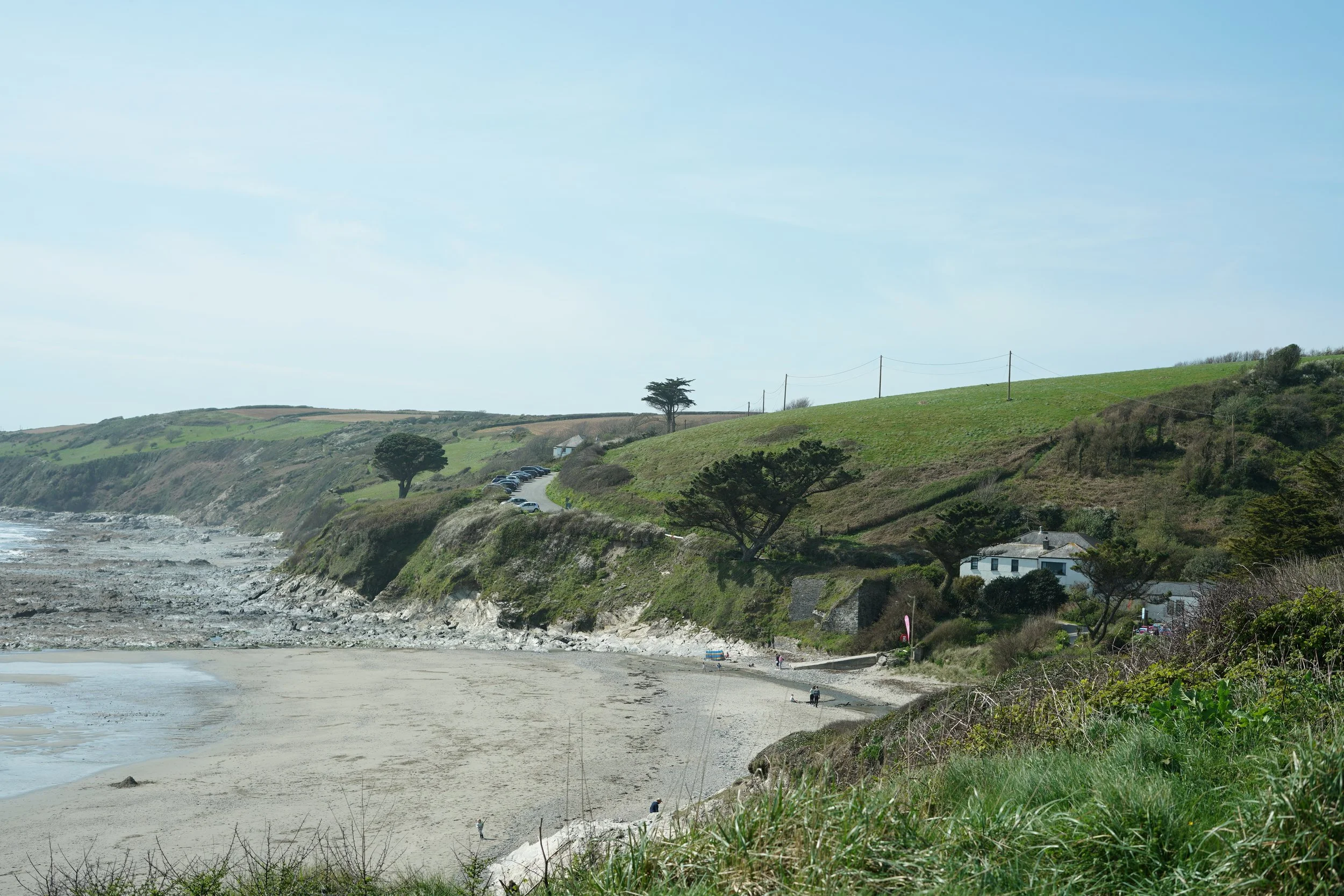
I have been involved with planning issues at Pendower for many years, both in my former role as Partnership Manager for the Cornwall National Landscape and subsequently in private practice, supporting the Friends of Pendower Beach in responding to various planning applications and design iterations that have emerged over the years.
The story of the proposed redevelopment of the former Pendower Beach House Hotel — the much-loved “Pink Hotel” — has been unfolding for some considerable time now. Previous proposals were withdrawn, and the latest application, PA24/00042, was substantially revised from the earlier schemes. Nevertheless, Cornwall Council ultimately refused the application in March 2025, for reasons of harm to the Cornwall National Landscape, given it was a major development within the protected landscape, and for its impact on the Pennarin Point to Porthscatho County Wildlife Site.
Following the refusal, it was expected that an appeal would ensue. However, the Planning Inspectorate felt that, given the sheer volume of information associated with the case, a Public Inquiry was necessary.
Why Pendower matters
As an expert witness, my responsibility was to examine the evidence and consider the proposal through the lenses of both ecology and landscape. That meant looking carefully at the character of the site, its relationship with the surrounding landscape, the ecological interests present, the potential effects of development and the adequacy of the measures proposed to avoid, minimise or compensate for those effects.
Pendower is a particularly sensitive place, even within the context of the National Landscape. Lying at the confluence of five markedly different character types, it is this juxtaposition of landscapes that gives it its unique distinctiveness and sensitivity.
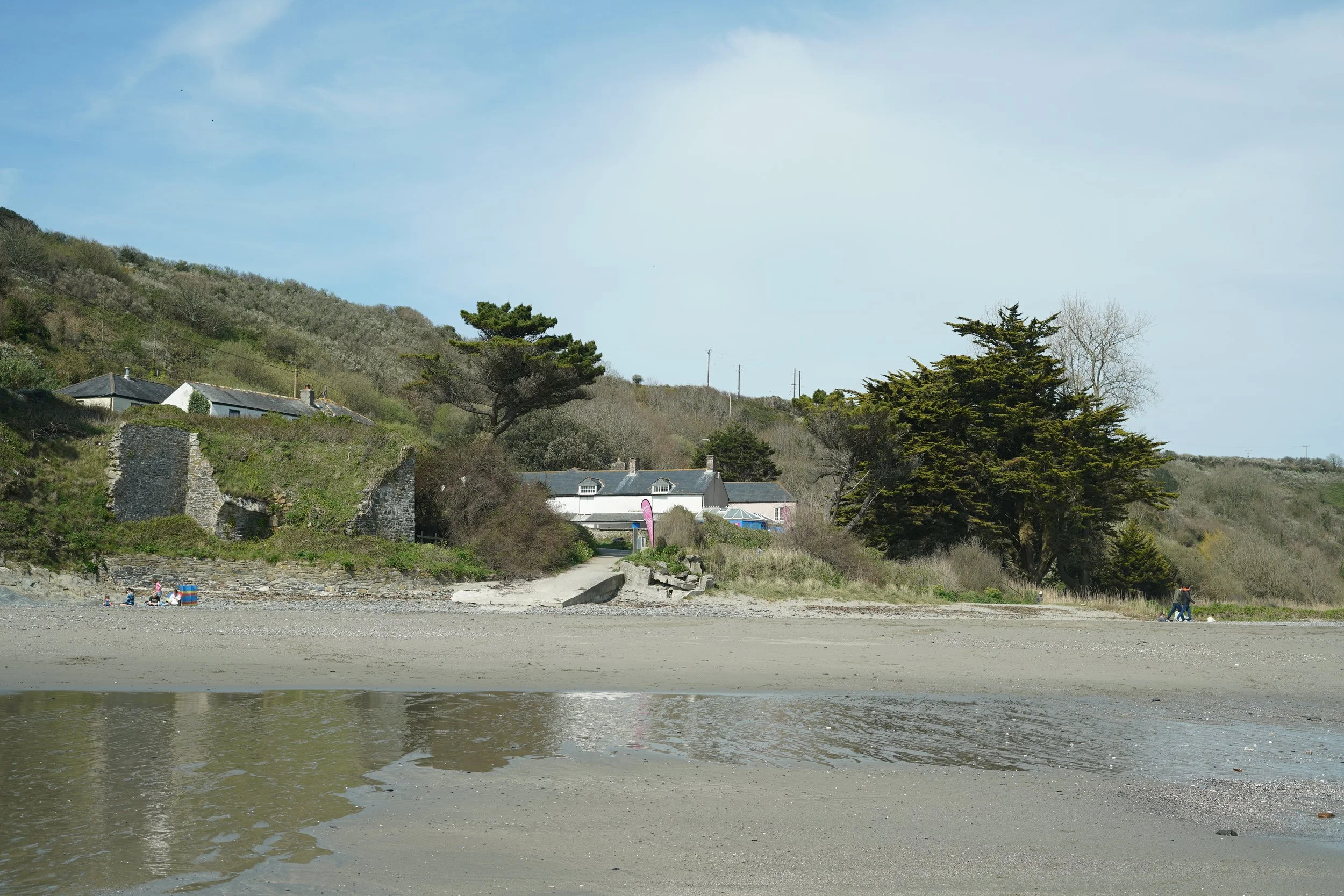
On top of that, is Pendower’s ecological significance, adjacent to a SSSI, SPA and SAC and partially within a County Wildlife Site.
It was always very clear that the debate could not sensibly be reduced to a question of whether a derelict building should be brought back into use, and that landscape and ecology would always be highly relevant to any proposal.
The Friends of Pendower have always been clear that they would support an appropriately designed solution to the current run-down collection of former hotel buildings centred on an original 17th-century farmhouse. However, that scheme would need to be landscape-led, appropriate in size and scale, avoid ecological impacts, and be respectful of the heritage asset. However, I strongly felt that the proposal before the Inquiry was materially not this.
The Public Inquiry
A public inquiry is demanding and completely consuming. The Friends of Pendower Beach were the Rule 6 party, and I assisted their case with my professional expertise. My job was to provide independent professional evidence, to explain the ecology and landscape issues clearly, and to test the evidence put forward in support of the development.
An inquiry brings together detailed technical reporting across all relevant issues, with all evidence summarised in the Proof of Evidence. The process of reading all the technical reports attached to the original planning applications, appeal documents, Statements of Case, Statement of Common Ground, Proofs of Evidence, and rebuttals is time-consuming and requires enormous concentration and attention to detail.
Preparing for the actual Inquiry is a test in itself, developing the presentation of evidence in chief and meticulous preparation for cross-examination, attempting to hold in your mind every conclusion on ecology and landscape, every important paragraph and everything you want to make the Inspector aware of.
The Inquiry itself was stimulating, daunting, and deeply interesting in equal measure, as the Inspector, Rachael Pipkin, expertly navigated the hearing of evidence and cross-examinations, making sense of the arguments and competing interpretations of what the evidence meant.
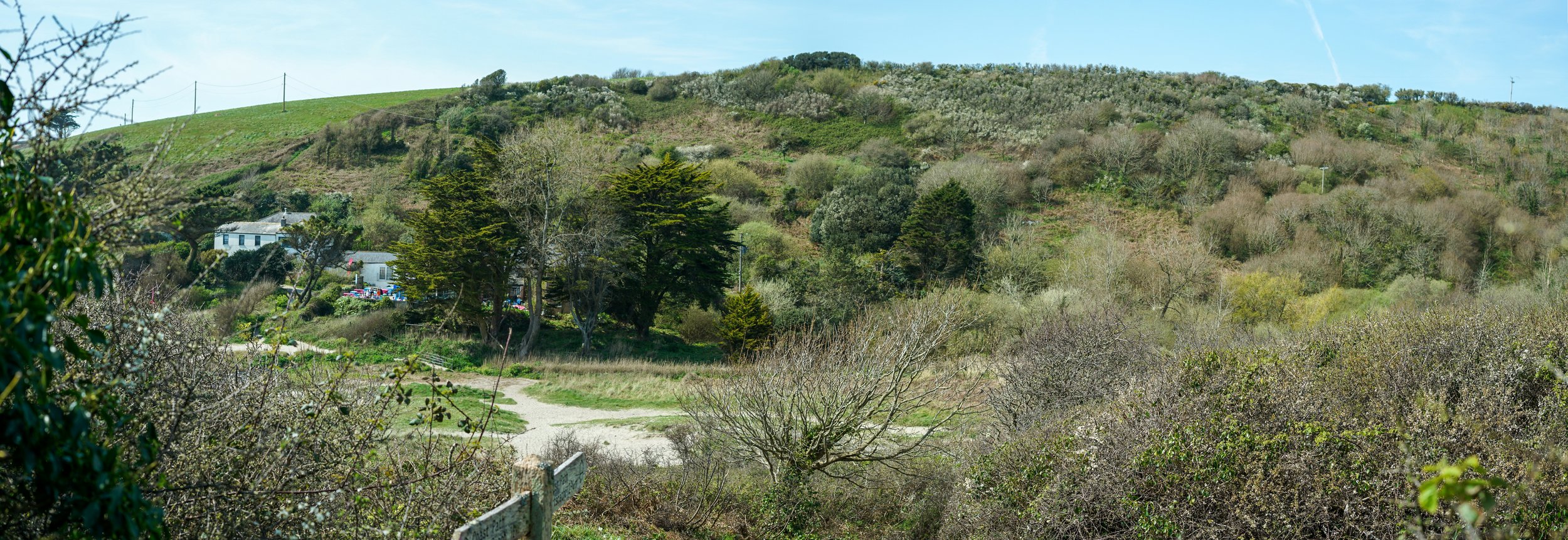
The Pendower Beach Hotel from the South West Coast Path
Principled evidence
For me, the most important thing was to keep coming back to the key question…What would this proposal actually mean for Pendower? My evidence was not a lengthy rehash of the landscape and visual impact assessments or a shadow biodiversity net gain assessment. Sure, it covered technical aspects, but I found it useful to return to the fundamental principles that would determine whether the development was policy-compliant.
· How would the proposal change the character of Pendower?
· What would the visibility of this proposed new settlement be?
· Would there be cumulative impacts with the proposal and other forms of development locally?
· Would the development sit comfortably within this extraordinarily sensitive coastal setting?
· Would ecological interests genuinely be protected?
· Was the ecological mitigation strategy appropriate for the place, and had the mitigation hierarchy been followed?
· Would proposed mitigation actually deliver ecological enhancement?
· And, perhaps most importantly, was the scale and form of development appropriate to the landscape in which it was being proposed?
And the most useful question when pulling together evidence… Is this going to be helpful to the Inspector?
The arguments
I had already helped the Friends of Pendower broadly marshal the arguments at the planning application stage, and these were fleshed out in the run-up to and during the Inquiry. The Friends of Pendower’s case rested on two main pillars, landscape and ecology, summarised briefly as.
Landscape
· The proposal represented a major development within the Cornwall National Landscape that cannot be moderated or mitigated in a way that would conserve and enhance the National Landscape.
· The proposed development was not landscape-led and introduced a significantly increased quantum of development, adversely impacting landscape character.
· The condition of the existing hotel did not justify introducing a development that would cause harm.
· The development gave rise to cumulative impacts with existing development to the east.
· The development neither conserves nor enhances the National Landscape and would harm the special qualities of the Roseland Heritage Coast.
Ecology
· The mitigation hierarchy had not been adequately followed, resulting in harm to the valley's ecology within the Pennarin Point to Porthscatho County Wildlife Site and adjacent habitats, regardless of the results of the Biodiversity Net Gain Metric.
· The development introduced built development within the CWS boundary, which is a concern for the whole CWS network.
· The demonstration of Biodiversity Net Gain did not mean that the development automatically satisfied broader planning policies designed to protect and enhance biodiversity or that it accorded with the aims of the Cornwall Local Nature Recovery Strategy.
· Biodiversity Net Gain had not been sufficiently evidenced.
The right outcome
After hearing all the arguments, the Inspector dismissed the appeal. The Appeal Decision can be viewed here.
The Inquiry, for me, demonstrated the rigour of the planning system and the process behind a public inquiry, which enables proposals to be rigorously tested. Indeed, after almost four hours of cross-examination at the hands of an extremely sharp and experienced planning barrister, I did feel rigorously tested!! The importance of the public Inquiry is in providing an opportunity for the issues that matter to be properly examined.
Public inquiries can sometimes seem remote from everyday life, full of technical language and procedural rules. But fundamentally they are about making decisions that can have consequences for places for decades. For me, participating as an expert witness was about ensuring that ecology and landscape were properly understood in that decision-making process.
It was really about giving Pendower Beach itself a voice.
My thanks go to the whole team who worked hard to deliver the right result for Pendower. Helen Hastings, Chair of the Friends of Pendower and all of the local community who supported the effort; Edward Arash-Abedian, our excellent barrister from Landmark Chambers; and Lisa Foster and Csongor Szij from Richard Buxton Solicitors.